AI Visibility / MFGSEO Insights
Dormant Accounts Are an Orchestration Problem, Not a Content Problem
Why dormant social accounts need governed content orchestration—not more captions—and how to build a portable AI publishing workflow.
By Alex Rodriguez ·
# Dormant Accounts Are an Orchestration Problem, Not a Content Problem
Most dormant social accounts do not have an ideas problem.
They have an **operating-system problem**.
The business still knows what it sells. The team still has opinions, proof, subject-matter expertise, offers, old assets, and a reason to be visible. What disappeared was the mechanism that turns any of that into consistent, approved, published work without forcing one person to babysit every handoff.
That distinction matters now because AI has made content production cheap. A team can get concepts, captions, scripts, image directions, revisions, and channel-specific variations in minutes. The bottleneck moved downstream.
> The hard question is no longer, “What should we post?” It is, “How does a verified instruction move from idea to published output—and get measured—without creating a new manual job?”
That is an orchestration question.
## The Wrong Diagnosis Creates the Wrong Fix
When a business has not posted in six months, the usual response is to buy a content tool, hire a freelancer, or ask an AI assistant for 30 captions. None of those options is inherently wrong. They just solve the narrowest part of the system: production.
The actual workflow still has to decide what is safe to say, which offer matters this month, which account gets the post, what media is approved, who signs off, what link belongs in the caption, whether the post actually went live, and how that outcome changes the next cycle.
| Surface problem | What is usually happening underneath |
|---|---|
| “We never know what to post.” | No current source of truth for positioning, offers, audience, proof, or content priorities. |
| “The team does not have time to post.” | Publishing requires too many manual handoffs across writing, media, approvals, platform access, and reporting. |
| “We tried automation and it felt off-brand.” | The automation had no constrained brief, approval boundary, or brand-rule layer. |
| “We made content but nothing changed.” | No connection between content activity, destination, campaign context, and measurable business outcome. |
The unit of work is not the caption. It is the **completed, accountable publishing loop**.
## What an Orchestrated Publishing System Actually Looks Like
An operating model does not need one giant agent that researches, writes, designs, publishes, analyzes, responds to customers, updates the CRM, and understands the entire company. That is usually the fastest path to unclear permissions and unreliable output.
The better model uses defined layers with explicit handoffs.
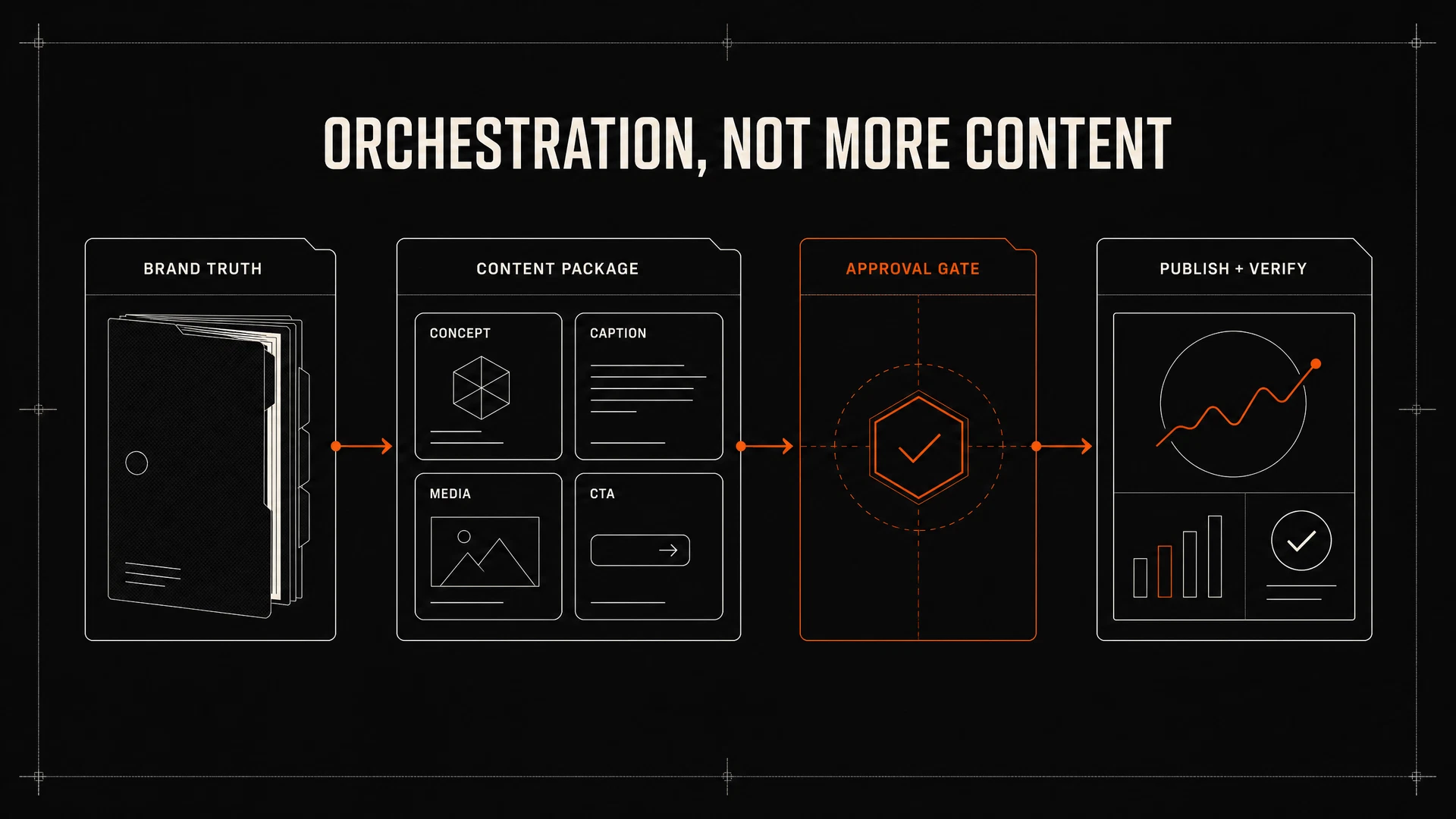
| Layer | Job | What it should own |
|---|---|---|
| Strategy and context | Maintains business truth | Who the business is, what it does, where it operates, differentiators, offers, proof, prohibited claims, current priorities. |
| Content preparation | Converts truth into a publishable package | Concept, draft, asset direction, destination, link, campaign context, and publishing notes. |
| Review and approval | Controls risk | Approval for sensitive claims, pricing, legal language, customer references, and deviations from approved categories. |
| Execution | Performs the repetitive platform task | Scheduled publishing or controlled browser/desktop actions in approved accounts only. |
| Verification and reporting | Closes the loop | Evidence of publication, URL or post ID, errors, performance signal, and next-cycle recommendation. |
This is why agentic tools are becoming interesting. Not because they can generate another caption. They create a possible execution layer between a structured content package and the actual platform interface. That execution layer still needs boundaries, permissions, logs, and a way to be replaced when the tool changes.
## A Dormant Account Is a Good Test Environment
Dormant accounts are a useful test case because the business already exists. There are usually historical posts, existing followers, brand materials, and enough context to define a controlled restart. The goal is not to produce volume. The goal is to prove that a small system can operate reliably.
Start with the minimum viable loop:
1. Establish a verified source of truth for the brand.
2. Build a small queue of useful, approved content themes.
3. Require human approval where the business risk is real.
4. Allow an execution agent to complete only the repetitive publishing steps.
5. Record what was published, where, and with what link or campaign context.
6. Review outcomes before increasing frequency or autonomy.
This turns “post every Tuesday” from a vague recurring obligation into a controlled workflow with inputs, outputs, and decision rights.
## The Source of Truth Is the First Asset—not the AI Prompt
Before a business gives an agent publishing access, it needs a source of truth that an operator can inspect. The record should answer the five questions buyers, platforms, search engines, and AI systems need answered consistently.
| Required truth | Operational use |
|---|---|
| **Who they are** | Legal/brand name, owner or spokesperson, category, approved identity references. |
| **What they do** | Service pathways, products, offers, exclusions, and claims the team can support. |
| **Where they do it** | Markets, locations, service areas, account ownership, and local relevance constraints. |
| **Why they are different** | Proof, operating differentiators, workforce or technology advantages, and approved evidence. |
| **How people take action** | Approved CTAs, destination URLs, lead routing, booking paths, and campaign tracking. |
Without this layer, every content request begins by reconstructing the business from memory. That is not automation. It is repeated ambiguity.
With it, a content-preparation system can turn a priority into a specific package: a post angle, approved message, media requirement, platform destination, CTA, and review requirement. The execution layer does not have to guess what the business means.
## Better Instructions Beat More Autonomy
The dangerous sequence is simple:
> Brain dump → give a bot access to everything → hope.
The durable sequence is different:
> Brain dump → organize intent → define rules → define permissions → execute → verify.
That difference is governance, not bureaucracy. For a dormant account, the rules can remain practical:
- Approved accounts and account owners.
- Approved content categories and publication frequency.
- Prohibited claims, sensitive topics, and audience exclusions.
- Required links, disclosures, or location references.
- The exact point where human approval is mandatory.
- What the agent can edit, what it can schedule, and what it must never delete.
- What happens when a platform UI changes or a publishing attempt fails.
- What evidence must be logged after every attempt.
Autonomy should match risk. An agent can safely prepare a queue, format a caption, assemble a draft, and report a failed publish attempt long before it should make broad decisions about offers, pricing, customer claims, or public responses.
## The Tool Cannot Be the Architecture
Today it might be a browser agent, a social scheduling platform, a custom workflow, or an AI workspace with connected tools. Six months from now it may be something else. That is normal.
The architecture should survive the swap.
If your brand rules, source material, approved assets, permissions, publishing log, and measurement framework only exist inside one vendor’s agent, you do not own an operating system. You own a dependency.
Portable systems separate the stable layer from the changing layer:
| Stable operating asset | Replaceable execution asset |
|---|---|
| Brand source of truth | Chat model or AI workspace |
| Content rules and approval matrix | Caption-generation tool |
| Asset library and naming system | Image/video generator |
| Publishing checklist and log | Browser agent or scheduler |
| UTM and measurement rules | Analytics or reporting interface |
This is the same reason enterprise search architecture matters. The platform is not the system. The system is the structured business truth, the decision model, and the governed handoffs that let execution tools do useful work without becoming the single point of failure.
## From Dormant Account to Operating Leverage
There is a bigger lesson here. AI content is becoming a commodity. The leverage does not come from generating more drafts than the next company. It comes from reducing friction between **idea → instruction → asset → execution → measurement**.
A dormant account is simply the cleanest place to test it. The stakes are controlled. The business can define the rules. The team can see where the workflow breaks. And once the system works for one account, the same architecture can support local pages, email workflows, partner content, sales enablement, customer education, and demand-generation campaigns.
The account does not necessarily need more creativity.
It needs a reliable system that can carry good decisions through to verified execution.
This is the same decision-architecture problem behind [prompt engineering failures](/blog/prompt-engineering-not-the-bottleneck): a more capable tool cannot compensate for an unclear operating model. It is also why [enterprise search architecture](/blog/enterprise-search-architecture-ai-speed) has to be portable. The tool may change; the truth, rules, and handoffs cannot disappear with it.
## Build the Operating System Before You Add the Agent
If your team has channels that went quiet because publishing became another job nobody owned, the first move is not to add unrestricted AI access. Start by mapping the source of truth, the approval boundary, the execution handoff, and the reporting loop.
That is what makes automation durable—and what makes it safe to scale.
MFGSEO helps teams diagnose the operating constraints between visibility, content architecture, conversion paths, and qualified pipeline. The **Alignment Sprint** turns the loose system into a prioritized operating model your team can run with or without the same toolset.
[Book an Alignment Sprint](https://mfgseo.com/sprint)
## FAQ
### What is content orchestration?
Content orchestration is the system that coordinates strategy, source material, production, approvals, publishing, and reporting across people and tools. It is broader than AI content generation because it governs how work moves to a verified outcome.
### Why do social media accounts become dormant?
They often become dormant because the workflow depends on repeated manual coordination. Ideas, assets, approvals, platform access, publishing, and reporting are handled as disconnected tasks rather than one accountable operating loop.
### Should an AI agent publish social media posts without approval?
Only for low-risk, pre-approved work. Start with defined permissions and human approvals for claims, pricing, legal language, customer references, public responses, or anything outside approved content categories.
### What should a source of truth include for AI publishing?
It should define the business identity, services or products, locations or service areas, differentiators, approved claims, voice, content categories, prohibited language, CTAs, links, and approval rules.
### How do you make an AI content workflow portable?
Keep the brand source of truth, assets, rules, permissions, logs, and measurement framework outside the execution tool. Then a browser agent, scheduler, model, or content platform can be replaced without rebuilding the operating model.
## References
[1] [Writer, “Agentic AI for Marketing Teams”](https://writer.com/blog/agentic-ai-marketing/)
[2] [Pedowitz Group, “Can AI Agents Handle Social Media Management Autonomously?”](https://www.pedowitzgroup.com/can-ai-agents-handle-social-media-management-autonomously-governance-playbooks)